Indoor Air Quality affects health, productivity, and building operations, yet many risks are often not visible.
as carbon dioxide, particulate matter, volatile organic compounds, and biological contaminants are difficult to monitor and manage using conventional approaches alone. These remain unnoticed until they impact occupants. By analysing data from environmental sensors, building systems, and occupancy patterns, an AI application enables real-time visibility into indoor air conditions. It will support the early detection of high-risk scenarios, thereby improving the identification and management of IAQ risks.
Integrating AI into HVACR systems is revolutionising building operations and maintenance management.
AI Opportunities in IAQ Management
Artificial Intelligence is shaping how solutions are designed, validated, and optimised in the built environment. It is no longer limited to automation; it now guides decision-making on whether a building or property requires intervention. Mr. Ashutosh R. Thakur, Founder & CEO at Schillings Air, explains that AI gathers data through installed sensors within a property. The system continuously monitors performance, captures behavioural patterns, and presents actionable data for interpretation.
Drawing on field experience in HVAC system performance testing, Mr. Ashutosh combines engineering with AI-driven analytics to understand how systems are designed and how they perform. The objective is not merely technological sophistication, but optimisation—ensuring that any corrective or enhancement step does not become a financial burden for property managers or an operational strain for facility teams. AI enables precision in decision-making, reducing unnecessary capital and recurring expenditures. He cites a practical example: in one project, VOC (Volatile Organic Compound) levels were found to be high, while PM2.5 and PM1 concentrations remained stable and well below global thresholds.
The natural question arose—was a HEPA filtration upgrade truly required? Data analytics revealed that the primary concern was VOC mitigation, not particulate matter. Instead of recommending an expensive and potentially redundant solution, the system was tailored to address VOC elimination, which constituted 99% of the concern. This illustrates how AI prevents over-engineering and ensures targeted, cost-effective interventions.
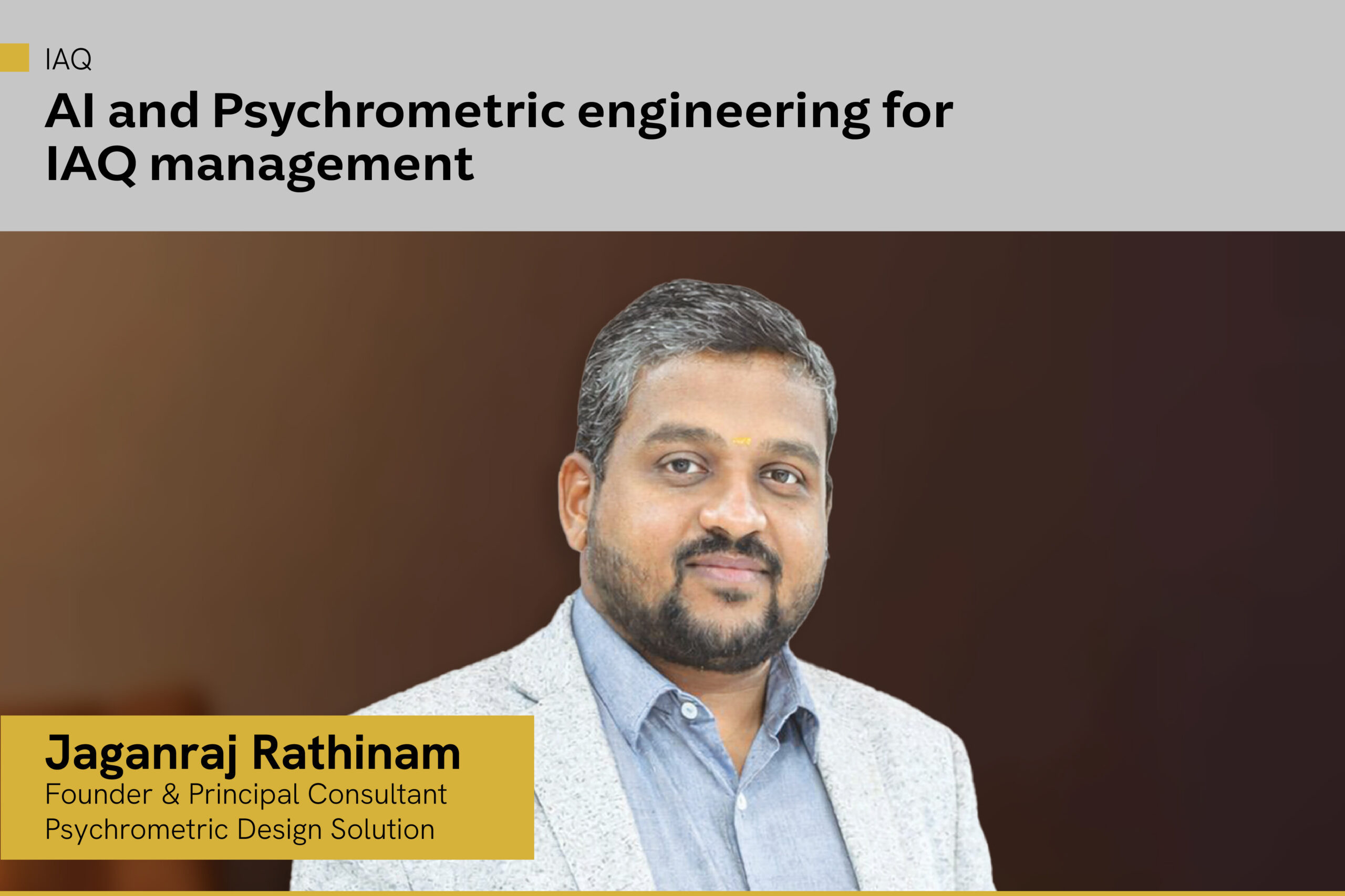
However, AI is not a substitute for engineering fundamentals. Mr. Jaganraj Rathinam, Founder & Principal Consultant at Psychrometric Design Solution, emphasises that if the system design is incorrect and the fundamentals are flawed, then AI cannot push the system to its limits. AI has certain limitations. If the system is properly designed, AI can do wonders. Where necessary, engineering redesign must precede AI optimisation to enable AI to deliver good results.
Mr. Neeraj Kumar, Chief Product Officer at HiboCare, describes AI as a diagnostic instrument. Indoor air quality monitors deployed across a facility function much like a multi-lead ECG—each sensor capturing localised data to reveal systemic imbalances. Through multivariate analysis, AI can pinpoint whether an issue stems from design deficiencies, poor operations, or inadequate maintenance. For instance, neglected filters can disrupt pressure balance, affecting ventilation performance. AI identifies the origin of such deviations with clarity.
It may be a design problem or an operations and maintenance issue. AI can assist in managing IAQ. From predictive maintenance to redesign validation and retrospective analysis, AI strengthens IAQ management.
AI-managed IAQ solution
Asserting his views, Mr. Jaganraj Rathinam says, it is helpful. For example, retrofitting is happening broadly. Replacing motors with energy-efficient motors, replacing filters with highly efficient filters — AI can give information. There is a limitation. AI can only give information. It cannot redesign the system. It can be said that CO₂ levels are increasing, and PM levels are rising at this level. These pieces of information can be analysed. Accordingly, we can redesign the system. Engineering principles are needed. Skilled professionals are needed.
From the perspective of Birlasoft Facilities Manager Mr. Sanosh Kamble, integrating AI-driven IAQ solutions into existing facilities shouldn’t add to operational complexity. The key is to position AI as a support layer rather than a replacement for established systems. Instead of displacing the Building Management System (BMS), AI should sit above it—analysing trends, identifying patterns, and recommending actions—while the BMS continues to execute control strategies. This ensures facility teams are not forced to learn or manage an entirely new platform.
Any integration should begin by using what is already installed. Existing CO₂ sensors, temperature readings, airflow data, and scheduling inputs provide a strong foundation. AI should filter transient or harmless spikes and escalate only persistent, meaningful IAQ risks. This directly addresses alarm fatigue—one of the most common operational challenges in modern buildings.
Insights must be practical and easy to interpret. Teams need clear messages—such as ventilation delay or pressure imbalance—so that corrective action can be taken without complex analytics. Instead of appearing across different dashboards, alerts should be part of the BMS alarm structure and maintenance routines. AI should initially function in advisory mode, allowing teams to validate recommendations. Manual override must always remain available. Its true value lies in reducing unnecessary alarms, minimising complaints, optimising energy use, and reducing maintenance costs. When these operational improvements are visible, AI adoption and integration prove their effectiveness.
AI adoption
AI adoption for IAQ cannot follow a uniform path across all building environments. As Mr Santosh explains, prioritisation depends on three core parameters: risk to human health, operational criticality, and value creation. Since every building serves a different function, the urgency and expectations from AI naturally vary.
Healthcare facilities stand at the highest priority. In these environments, air quality influences patient recovery, immunity, and overall clinical outcomes. Infection control and regulatory compliance are non-negotiable. AI plays a crucial role in dynamically managing airflow, pressure relationships, filtration efficiency, and humidity levels. Early detection of ventilation or filtration failure is essential, as delays can have serious consequences. Here, adoption is driven by risk reduction and safety rather than energy savings, and there is a higher tolerance for technological complexity because the stakes are critical.
Commercial office spaces come next. The focus shifts toward employee well-being, productivity, and energy optimisation. Poor IAQ affects concentration, fatigue levels, and even retention. With hybrid work patterns and fluctuating occupancy in meeting rooms, AI helps balance ventilation demand with efficiency. The business case is clearer in offices because reduced complaints and measurable energy savings provide a visible return on investment. However, solutions must simplify facility management operations rather than complicate them.
In schools and educational institutions, the priority centres on student health and learning performance. Elevated CO₂ levels are directly linked to attention and cognitive function. AI can help maintain healthy indoor air within tight budget constraints while offering transparency to parents and regulators. Adoption often progresses in phases due to funding limitations, and systems must remain simple, reliable, and cost-conscious.
Residential buildings see gradual and selective adoption. While IAQ risks exist, they are less centralised than in institutional settings. Deployment is more common in pollution-prone regions or premium, high-density housing. In this segment, simplicity, privacy, and affordability are essential. AI works best when quietly embedded within smart home ecosystems without adding operational burden.
Mr. Neeraj Shukla points out that adoption also depends heavily on the availability and suitability of solutions. Many current offerings remain at a primitive stage. In several cases, so-called AI dashboards function more like Q&A interfaces, providing high-level insights rather than delivering agentic, precise decision support. For meaningful progress, AI innovators and industry adopters must move together toward practical applications across all stages of deployment.
Some global manufacturers, such as Schneider Electric, have integrated AI layers into their BMS platforms. However, access to such capabilities depends on whether that infrastructure already exists in the building. Beyond these ecosystems, plug-and-play options remain limited. That said, the situation is not discouraging. The market is still evolving, leaving significant room for innovation. What the industry needs are practical, easy-to-deploy solutions that deliver actionable insights without complexity. The opportunity lies in making AI accessible, adaptable, and operational with monitoring approaches across diverse building environments.
Instead of operating continuously at fixed settings, intelligent systems can respond to changing indoor and outdoor environments. Dr. Hitesh Rawate, Deputy General Manager (R&D) at Novorbis Itus, notes that once the desired air quality level is achieved, the system can shift to a low-power or standby mode, resulting in significant energy savings. Over time, machine learning algorithms can train the system based on weather patterns, occupancy behaviour, and climatic variations. This reduces the need for manual intervention and improves reliability. The integration of AI is therefore essential for balancing energy efficiency with health-focused indoor air quality objectives.
Prioritise IAQ risks compared to monitoring
Mr. Neeraj Kumar observes that one thing we need to understand is that AI will not replace monitoring. We still need monitoring. Otherwise, AI always gives you an answer, whether it knows it or not. So if you give it less information, it will start hallucinating and giving you answers that won’t be very productive.
So we need to keep that in mind — AI is like a very intelligent child that can process any information, but it’s also naïve. It will make mistakes if you don’t guide it. So monitoring is extremely important. Where AI comes in is that it can take that data point and explain it in a way that actually points to the problem. For example, the same PM2.5 level in a room could be due to many different reasons. The answer may lie in other indicators. Like CO₂ levels or VOC levels, because VOCs tell us about indoor sources of problems.
Significant VOC accumulation indicates inadequate ventilation. It indicates that the room is the true source of the PM2.5. Which means we need more recirculation rather than bringing in more fresh air. AI can elicit different data points and interpret them in an actionable way for the specific problem at hand.
Strategies to eliminate IAQ risk
Mr. Ashutosh says that, at some point, you have to take measures. The air we breathe is unacceptable. It’s just not there. So we filter it. Understandably, India should be the biggest market for air purification. You go to China, Vietnam, or Cambodia — the air quality is the same.
The road you were travelling on five years ago has changed completely. There are five new flyovers on it. But it’s a price you pay for development. Every country has faced it. Moving on, Europe is one of the largest markets for air purifiers. The reason is that air purification is not just for particulate matter or gases — it’s also for allergies, viruses, and pollen. AI starts giving us facts, data, and analysis, and we know what we are dealing with.
Where do we report that someone’s office is suffering from a huge amount of formaldehyde because one of the industries in the neighbourhood is not taking measures to eliminate emissions from factories? Where do we report that? We have the data. We did the engineering. Someone is safe inside his property now. But ensure that the factors deteriorating the situation are given attention. So, we are solving the problem first. Then at some point, the government will have to accept that it’s a development issue. We need to take care of our people and occupants inside properties.
AI to future ambivalence
By learning from historical trends, outdoor AQI, occupancy patterns, and internal pollutant generation, the systems predict particulate and VOC spikes and proactively adjust filtration and ventilation. This is especially critical in polluted urban environments where outdoor air is not always cleaner than indoor air.
We must take measures, not just rely on technologies and engineering, but also on policies. AI is unable to correct poor design, inadequate ventilation, insufficient machinery, or neglected maintenance. Engineering fundamentals must be done right first; only then can AI deliver meaningful optimisation.
====
Mr. Jaganraj Rathinam, Founder & Principal Consultant, Psychrometric Design Solutions
When AI synchronises with BMS and timers, ventilation starts automatically, reducing manpower dependency and preventing Monday morning IAQ lapses.
Mr. Sanosh Kamble, Facilities Manager, Birlasoft
AI should enhance the BMS by analysing trends and recommending actions, while the BMS continues executing core control functions.
Mr. Neeraj Kumar, Chief Product Officer, HiboCare
AI must integrate with control systems; otherwise, delayed manual responses reduce the time-sensitive value of IAQ insights.
Mr. Ashutosh R Thakur, Founder and CEO, Schillings Air
AI predicts and identifies problems, but engineering solves them through ventilation, filtration, and airflow design at the physical layer.
Dr. Hitesh Rawate, Deputy General Manager (R&D), Novorbis Itus Pvt. Ltd.
The integration of AI is therefore essential for balancing energy efficiency with health-focused indoor air quality objectives.
Neeraj Gupta, Deputy Head, Business Operations, Living Environment Division, Mitsubishi Electric India
Knowledge of data analytics for predictive maintenance and AI integration is essential to optimise operational performance and costs.
Sandeep Vasant, Program Chair – ISHRAE Bangalore Chapter, and Zonal Youth Chair – South Zone, ISHRAE HQ