Indoor air quality influences comfort, health, and productivity. By combining AI-driven analytics with psychrometric engineering, buildings can proactively manage air quality, optimise energy use, and enhance occupant wellbeing.
Many people feel tired and uncomfortable even in an air-conditioned room. This often happens because of an invisible problem—the quality of the air. Many people are not aware of this issue.
Many organisations are implementing various technologies in their facilities. However, in Tier-2 and Tier-3 cities, customers are often unaware of the importance of air quality and thermal comfort. As consultants, it is our responsibility to educate end users and HVAC contractors about indoor air quality.
How AI and psychrometric engineering manage invisible IAQ risks
We spend nearly 90% of our time indoors—inside buildings, automobiles, and other conditioned environments. Healthy air means comfortable air, and comfortable air improves productivity. When indoor air quality is poor, productivity decreases, and long-term health issues can arise. In fact, it is often referred to as ‘sick building syndrome’, which generally occurs when indoor air quality is inadequate.
ASHRAE defines acceptable indoor air quality as an environment in which there are no known contaminants at harmful concentrations, as determined by authorities, and where a substantial majority (80% or more) of occupants do not express dissatisfaction. This definition highlights two important aspects: health-based criteria, which focus on contaminant limits, and comfort-based criteria, which focus on perceived air quality.
Invisible IAQ risks within buildings
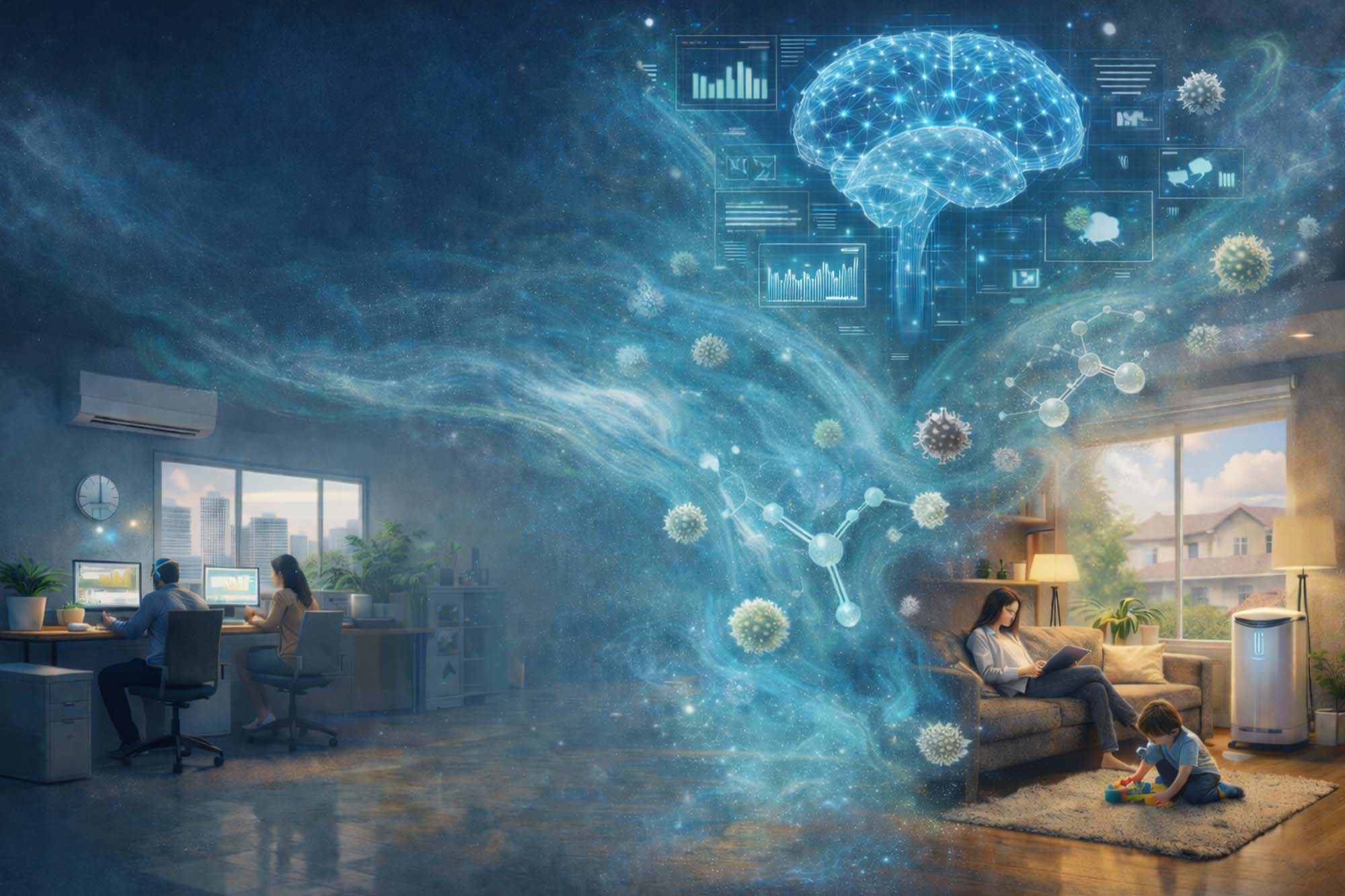
One of the most common issues is thermal discomfort. Many people say, “I have set the temperature at 24°C or 25°C, but I still do not feel comfortable.” This discomfort may not be due solely to temperature. It could result from humidity issues, poor air quality, unseen moisture, unbalanced latent and sensible loads, undetected CO₂ accumulation, VOC build-up, or microbial growth caused by poor psychrometric control.
Many facilities do not monitor CO₂ or VOC levels within conditioned spaces. If a system is not properly designed, microbial growth can develop in conditioned environments. In simple terms, these issues are referred to as thermal discomfort.
Unfortunately, such problems are usually identified only after occupants begin complaining. Once complaints arise, facility managers begin investigating possible causes, such as plumbing leaks or equipment malfunctions, only to discover that the root cause lies in the air-conditioning system and indoor air quality.
Traditional IAQ monitoring systems have several limitations. Earlier technologies often suffered from sensor inaccuracies, calibration issues, and standalone monitoring devices that were not connected to HVAC controls. In many cases, these systems merely displayed IAQ data without enabling any corrective action. Monitoring air quality alone provides limited value if the data cannot be used to improve conditions.
Today, however, a wide range of sensors is available, including CO₂ sensors, Occupancy and motion sensors, Light sensors, Airflow meters, VOC sensors, PM2.5 and PM10 sensors, Smoke sensors, Filter condition sensors and Differential pressure sensors.
How can AI enhance these systems?
Based on our experience working on numerous projects, collaborating with OEM manufacturers, and engaging with research scholars focused on indoor air quality and thermal comfort, we find that AI can identify patterns in temperature, relative humidity, CO₂ levels, VOC concentrations, PM2.5, PM10, and filtration performance within air-conditioned buildings.
AI recognises trends rather than isolated data points. It can determine when temperatures rise or fall, when humidity changes, when CO₂ levels peak, and how these parameters behave over time. This pattern recognition enables early detection of issues.
Based on user requirements and sensor feedback, AI can automatically issue commands to building systems. For example, if occupancy data indicate that many people typically enter a building between 9:00 a.m. and 10:00 a.m., AI can instruct the AHU or ERV system to increase fresh-air intake during that period.
This is just one example of how AI converts sensor feedback into system responses. Such automation improves energy efficiency and decarbonisation goals.
AI converts raw data into useful operational decisions. It can also be integrated with psychrometric analysis to optimise cooling loads, ventilation rates, and dehumidification strategies. Performing these tasks manually is extremely challenging, whereas AI can quickly and accurately process and analyse large volumes of data.
As mentioned earlier, AI converts raw values into insights. It can perform root cause analysis when PM levels spike and correlate these events with outdoor infiltration, occupancy patterns, and movement trends. Unlike conventional IAQ monitors that provide only spot measurements, AI can analyse and map data across an entire facility.
The future lies in predictive ventilation.
AI continuously collects and analyses data, developing strategies based on thermal comfort requirements. It can forecast occupancy levels, evaluate indoor and outdoor weather conditions, and predict HVAC operating requirements based on historical data.
For example, AI can determine temperature requirements, optimise ventilation rates in accordance with ASHRAE standards, and automatically implement demand-controlled ventilation—the result of combining indoor air quality, energy efficiency, and occupant comfort.
There are many applications of AI-enabled IAQ systems:
- In schools, they can reduce CO₂ levels and lower the risk of airborne infection transmission.
- In hospitals, they can help reduce pathogen risks and monitor differential pressure requirements.
- In offices, they can improve occupant productivity and simplify ESG reporting.
- In residential buildings, they can enable smart air purification and allergy prevention.
Many countries in Europe and the United States are already emphasising IAQ in residential buildings. In India, however, the primary focus remains on commercial buildings, IT parks, and corporate facilities. Residential buildings represent an opportunity for future IAQ improvements.
In industrial environments, AI improves worker safety and automates compliance monitoring.
Overall, AI can help achieve three critical objectives: comfort, health, and energy efficiency. It can prevent over-ventilation, eliminate unnecessary reheating or overcooling, optimise outdoor air based on actual demand, and maintain comfort with minimum energy penalties. These capabilities can also support green building certifications and WELL Building Standards.
The future of healthy buildings includes digital twins, AI-driven operations, personalised comfort systems, infection resilience, and ESG transparency. As technologies emerge, greater emphasis must be placed on thermal comfort and overall indoor environmental quality.
Conclusion
AI-enabled IAQ management contributes to good indoor environments, improved occupant productivity, reduced energy consumption, maintenance strategies, compliance with ventilation standards and data-guided building management.
With proper AI configuration, predictive maintenance becomes possible. Instead of receiving an alert only after a filter becomes clogged, AI can predict when a filter is likely to reach the end of its service life and notify facility managers in advance—for example, indicating that a filter should be replaced within the next ten days.
However, AI does have limitations. AI enhances IAQ management, but it does not replace engineering expertise. Psychrometric principles are the foundation of successful HVAC and IAQ system design. A system must first be designed correctly before AI can deliver meaningful results.
I often tell young engineers that simply copying information from ChatGPT or any other source is not enough. If you do not understand the fundamentals or provide the correct inputs, you will not get meaningful outputs. A foundation in psychrometrics and indoor air quality is essential before AI can be used effectively. The best results come from combining AI, sound engineering design, and skilled professionals.
Expertise shared by:
Jaganraj Rathinam
Founder & Principal Consultant
PDS Climatic Consulting (A unit of ACE Integrated Engineering Services Pvt.Ltd)